How 0% Interest Bail Bond Financing Works in North Carolina
Families in Greensboro call during the hardest hours. A son is in booking at the Guilford County Detention Center. A spouse is waiting on a magistrate to decide the bond. The bond is more than the family can cover in one payment, but waiting another day is not an option. This is where 0 percent interest bail bond financing makes a real difference. It turns a lump-sum premium into predictable installments without adding interest or junk fees. It keeps a job on track, keeps a family stable, and keeps a case moving forward in court.
This article explains how interest-free bail bond payment plans work in North Carolina, with a focus on Greensboro and Guilford County. It uses real numbers, local addresses, and the current North Carolina legal framework that every family Have a peek at this website should know before choosing a bondsman or taking on high-cost debt. It is written for a mother at 2 a.m., a partner in Downtown Greensboro, or an employer near the Wendover Avenue corridor who needs someone clear and steady on the phone right now.
Why Greensboro families lean on payment plans when a bond hits
Greensboro is the county seat of Guilford County. Most arrests in the city route to the Guilford County Detention Center at 201 S Edgeworth St, Greensboro, NC 27401. The magistrate’s office operates on site at the same address, around the clock. The direct phone number to the detention center is (336) 641-2700. When a magistrate sets a secured bond, the next step is usually a surety bond through a licensed North Carolina bondsman. North Carolina law caps the premium, which is the nonrefundable fee for the bond, so families know the maximum that can be charged before they agree to anything.
North Carolina regulates that premium under N.C. Gen. Stat. §58-71-95. The premium is capped at 15 percent of the full bond amount or $150, whichever is higher. That cap applies statewide, including in Greensboro’s ZIP codes 27401, 27403, 27405, 27406, 27407, 27408, 27409, 27410, and 27455. In practice, most Guilford County bonds post with a premium between 10 and 15 percent, depending on risk and underwriting. Interest-free financing allows that lawful premium to be paid over time, without adding finance charges to the amount the law already permits.
Families ask if interest-free is real. In Greensboro it is. Apex Bail Bonds structures payment plans with 0 percent interest on financed premium balances up to $1 million. There are no financing fees and no hidden costs. This approach exists because families often turn to payday lenders to cover a shortfall on the premium. Those lenders can charge annual percentage rates in the triple digits. The result is a second crisis on top of the first. Interest-free bail financing avoids that spiral.
What 0 percent interest really looks like in dollars
Think in practical numbers. If a magistrate sets a $10,000 secured bond, the premium under the statute cap is up to $1,500. With an interest-free plan, a Greensboro family that qualifies can split that premium without paying a penny more than the $1,500. A common structure is half down and half later. Another structure in Guilford County is five percent down on bonds $5,000 and up. On the $10,000 example, that five percent down would be $500, with the remaining $1,000 financed over time at zero interest. The same pattern scales to larger bonds as well. Apex has financed premiums on six-figure bonds and has posted a $250,000 bond at the Greensboro jail in under two hours, which is a documented track record, not a wish.
On a $7,500 bond, the premium is up to $1,125. Five percent down would be $375. The rest can be scheduled in weekly, biweekly, or monthly installments that line up with a co-signer’s pay dates. A responsible payment plan with no interest is easier to keep current than a high-fee loan. That is why the plan structure matters more than the headline percentage alone.
Greensboro context that affects speed and cost
Speed depends on proximity to the jail and familiarity with the magistrate workflow. Apex Bail Bonds operates one block from the Guilford County Detention Center at 101 S Elm St, Suite 80, Greensboro, NC 27401. That proximity shaves time off the walk from the bondsman’s office to the magistrate window. It also shortens the gap between a co-signer signing a financing agreement and the actual posting of the bond. During late-night hours when staffing is thin, every small efficiency helps. It is common to see 2 to 4 hours from the time the bond is posted to the time the defendant walks out, depending on jail volume and any holds, such as warrants from other counties or an ICE detainer.
Families in Fisher Park, College Hill, Glenwood, Adams Farm, Irving Park, and the Battleground Avenue corridor often call from home to start the paperwork. Digital signatures are common. Co-signers can approve a payment plan by phone and text, then meet the bondsman at the detention center or the office if needed. In many cases, the entire financing approval happens over the phone with same-day underwriting. The key is to have basic information ready, which the bondsman will collect without making the process feel like a loan closing.
The North Carolina legal framework that shapes payment plans
The premium cap is the headline rule for cost. N.C. Gen. Stat. §58-71-95 limits the premium to 15 percent of the bond amount or $150, whichever is greater. Payment plans do not change the premium. They spread it across time at 0 percent interest when a bondsman offers that option. North Carolina also defines what a bail bond is and how courts must think about pretrial release. N.C. Gen. Stat. §15A-531 defines a bail bond as a written promise, with or without security, to appear in court. N.C. Gen. Stat. §15A-533 and §15A-534 set release presumptions and conditions, such as unsecured bonds, secured bonds, and house arrest. An unsecured bond is a paper promise to pay if the defendant misses court. A secured bond requires cash or a surety. A surety bond is what a licensed bondsman posts.
Iryna’s Law, which is Session Law 2025-93, effective December 1, 2025, shifted the release framework for violent offenses. The law created a rebuttable presumption against release for certain violent felonies, which means the default assumption is no condition will protect the public unless the defense brings forward evidence to overcome that assumption. For a first violent offense in that category, a judicial official must impose either a secured bond or house arrest with electronic monitoring. For repeat violent offenses, house arrest and stricter conditions are expected. The law also eliminated the written promise to appear as a release option under G.S. 15A-534(a). In plain English, more defendants will see secured bonds or house arrest, and that drives demand for financing the regulated premium.
Courts in Guilford County also follow administrative timelines that affect the bond life cycle. If a defendant misses court, state law sets a 90-day bond forfeiture timeline. That is the window before a forfeiture can become final, which would make the co-signer liable for the full bond amount. Judges must make written findings of fact in certain bond decisions. A 96-hour judge review requirement applies in specific contexts so early decisions by a magistrate get timely review. These rules matter for payment plans because a co-signer’s risk is tied to court attendance. A good bondsman explains those consequences before anyone signs. A great one also helps prevent missed court dates with reminders and quick action if a court date changes.
What families in Greensboro should expect when a payment plan is requested
Bondsmen look for the same core signals a bank might check, but with a faster and more practical lens. A co-signer who is 25 or older, has 12 months of continuous employment, and can verify a stable address is a strong candidate for interest-free financing. Pay stubs and a utility bill prove what is needed. An open checking account helps because it shows direct deposit patterns and because it allows predictable payments by card or bank transfer. A defendant who lives within 45 miles of the courthouse where the case will be heard also helps because it reduces flight risk. In Greensboro, that radius comfortably covers Summerfield, Jamestown, Pleasant Garden, Stokesdale, Oak Ridge, and McLeansville.
Credit scores get asked about, but they are not the driver. A steady job and a clear plan to make the scheduled payments carry more weight. Veterans, homeowners, and attorney referrals often qualify for special low rates. Returning clients sometimes receive discounted terms. Exceptions get made case by case, especially when a long employment history offsets a weaker credit file or an old bankruptcy. The goal is not to block a bond over a number on a credit report. The goal is to price the premium within the cap, structure a payment plan with zero interest, and reduce the chance that a co-signer gets into trouble later.
Collateral on Greensboro payment plans and when it is requested
Many Guilford County bonds do not require collateral. When collateral is requested, it is because the charge, bond size, or defendant history adds risk that a co-signer alone cannot balance. Felony cases with high bond amounts, failure to appear histories, drug trafficking allegations that involve mandatory minimums, or cases with out-of-state ties may trigger a collateral request. The detention center does not hold collateral. The bondsman documents it, secures it, and returns it when the case is resolved and the bond is discharged by the court, provided all payments on the premium are complete and no forfeiture occurred.
- Car title with a temporary lien, where the title is clear and the market value is documented Real estate deed of trust, with a preference for 100 percent equity or clear equity margins after mortgages Stocks and securities, verified with recent statements and control procedures Jewelry or electronics with receipts and serial numbers, documented with photos and itemized values Non-titled personal property with a bill of sale and a UCC filing to perfect a security interest
For real estate, value is measured by fair market value minus any encumbrances such as mortgages or liens. A deed of trust is the document that secures the property to the obligation. For vehicles, the lien is recorded with the title until the bond is exonerated. For smaller items, a secured agreement with photos and serials is normal. The bondsman explains the release conditions for the collateral in writing before taking any item. Families should avoid pawning property at steep discounts just to raise down-payment cash. If a collateralized plan makes more sense, a bondsman will say so and will document it correctly.
From booking to release in Guilford County, and where payment plans fit
Everything in Greensboro runs through the Guilford County Detention Center at 201 S Edgeworth St for city arrests. Booking collects fingerprints, a photograph, and biographical details. The magistrate sets the bond. If a bond is set as secured, a surety can post it at the magistrate’s office on site. The co-signer signs the bond paperwork and any financing agreement with the bondsman. Then the bond is walked to the window and posted. The defendant gets processed out. Release usually takes 2 to 4 hours after the bond is posted, with the shorter end of the range during slower overnight hours when there are fewer simultaneous releases. The detention center phone is (336) 641-2700. For High Point arrests, the Guilford County High Point Detention Center at 507 East Green Drive, High Point, NC 27260 handles intake, with a magistrate office on site. The High Point facility phone is (336) 641-7900.
Families can look up charges and bond amounts in the county’s online tool at inmatesearch.guilfordcountync.gov. The site provides booking numbers and status updates that help the bondsman draft the bond quickly and check for holds. Holds from other counties, probation violations, or a federal detainer can delay release. In those cases, payment plans are still useful because they secure the first bond and keep the case moving while the other issues are addressed. A clear timeline helps co-signers plan for the next few weeks of payments and for court dates at the Guilford County Courthouse at 201 S Eugene St, Greensboro, NC 27401, phone (336) 412-7300.
What makes payment plans in Greensboro different from a short-term loan
A short-term lender hands over cash for a price. An interest-free bail payment plan approves a lawful premium and schedules it without adding cost. The bondsman’s risk is the defendant’s failure to appear and the co-signer’s failure to pay the premium as agreed. The co-signer’s risk is the bond forfeiture if the defendant misses court and the court does not set the forfeiture aside. This is why bondsmen emphasize co-signer responsibility and court appearance reminders rather than credit scores and late fees. It is a different kind of underwriting. It is built to fit the North Carolina bail system and the Guilford County release process.
Payment plans also align with the 8th Amendment ban on excessive bail and Article I, Section 27 of the North Carolina Constitution, which echo the same principle. Those constitutional protections limit how high a court can set bail, but they do not pay the premium. A bondsman who finances at 0 percent interest carries part of the burden that would otherwise fall to expensive lenders. In practical terms, that keeps more defendants working at job sites in Greensboro, on shifts near Gate City Boulevard or New Garden Road, and in classes at the local colleges, rather than sitting in a cell for weeks because of an upfront cash gap on a lawful premium.
Large bonds, six-figure financing, and how risk is handled
Greensboro has seen six-figure bonds. Some involve allegations that fall under the violent offense category in Iryna’s Law. Some involve drug trafficking under N.C. Gen. Stat. §90-95(h), which carries mandatory minimums. Large bonds bring more moving pieces. The underwriting is deeper. The paperwork is thicker. But the principles are the same. The premium is still capped under §58-71-95, and payment plans can still be interest free. The difference is that collateral is often requested, and a larger down payment may be needed to match the higher risk profile. A good example is a half-down, half-later structure on a very large bond when the co-signer has strong income but limited liquid cash.
Apex Bail Bonds is known in the Triad for handling large bonds up to $1 million with same-day approvals when documents line up. A public example is a $250,000 bond posted in under 2 hours at the Greensboro jail. That level of speed happens because the office is a block from the detention center, because the magistrate staff and the bondsman understand each other’s paperwork, and because the co-signer had documents ready to verify employment and residence. In those cases, interest-free installments can still apply. The payment schedule just stretches longer to keep each installment reasonable.
How qualification really works for interest-free plans
There is no single formula, but patterns repeat. Co-signers who meet three markers almost always qualify for 0 percent interest premium financing on Greensboro bonds. First, age 25 or older with 12 months of continuous employment. Second, proof of residence with a utility bill and a stable address in Guilford County or within 45 miles of the courthouse. Third, a working phone and an open checking account or proof of property ownership. The bondsman will also ask about prior bankruptcies and any open collections that relate to court debt, which may affect the plan’s length or down payment. None of these items are automatic disqualifiers. They are pieces of a bigger picture that supports a responsible interest-free plan.
- Two current pay stubs and an employer contact, or recent tax records for self-employed co-signers Valid photo identification for the co-signer and defendant information for the bond A recent utility bill or lease that shows the co-signer’s address Bank card or checking account for scheduled payments with no convenience fee surprises Willingness to receive court-date reminders and stay in close contact until the case resolves
In some Guilford County cases, an accommodation bondsman signature is used. This is an additional licensed bondsman who signs on the bond as a risk control. It does not change the premium a family pays. It is a back-end risk measure that protects the bond and allows the primary bondsman to approve a plan that would otherwise be outside guidelines. The family will never feel that layer. It is explained, documented, and handled between the bondsmen and the court file.
What happens if a payment is missed or a court date changes
Payment plans work because they are predictable. If a payment is going to be late, co-signers should call before the due date. Bondsmen in Greensboro are practical. They know shifts get cut and childcare fails. Communication lets a bondsman adjust a schedule before it becomes a problem. If payments stop and there is no communication, the financing agreement allows the bondsman to take steps that can include moving to revoke the bond. That is a last resort because nobody wants a client back in custody. The goal is to keep the plan current and the defendant present at every court date.
If court is continued or a date is changed, the bondsman should be notified immediately. Guilford County often updates dockets electronically, but delays happen. Missed court dates trigger an order for arrest and start the bond forfeiture clock. North Carolina’s 90-day bond forfeiture timeline creates a window to set the forfeiture aside if there is a valid reason, but that is a stressful path that smart communication can avoid. Most payment plan clients in Greensboro never touch this process because reminders, group texts with family members, and simple calendar alerts keep everyone aligned.
Greensboro neighborhoods and nearby cities covered under financing
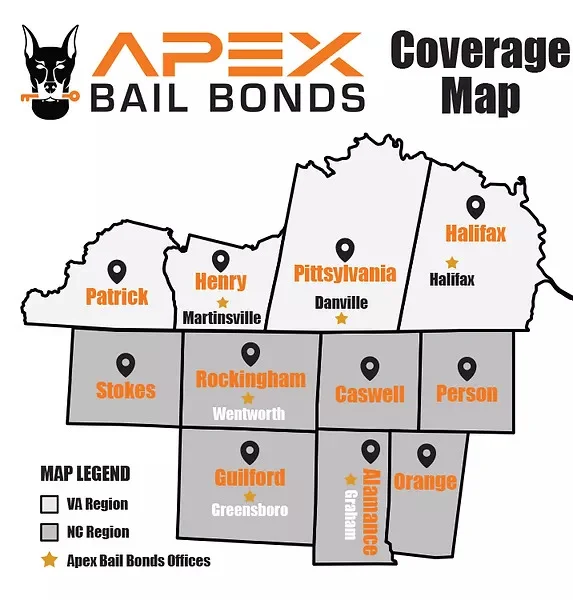
Interest-free bail bond payment plans in Greensboro extend across Downtown Greensboro, Fisher Park, Lindley Park, Irving Park, College Hill, Hamilton Lakes, Glenwood, Friendly Center, Adams Farm, Starmount, Westerwood, Sunset Hills, Sedgefield, and Green Valley. Service reaches along the Battleground Avenue and Wendover Avenue corridors and covers West Market Street, New Garden, and the Gate City Boulevard area. In Guilford County, coverage includes High Point, Jamestown, Oak Ridge, Summerfield, Pleasant Garden, Stokesdale, Colfax, McLeansville, Gibsonville, and Climax. Neighboring counties are frequently part of the plan discussion because defendants and co-signers move between Guilford, Rockingham, and Alamance counties for work and family.
When a Greensboro case connects to Rockingham County or Alamance County, coordination is straightforward. The Rockingham County Detention Center is at 170 NC-65, Reidsville, NC 27320, phone (336) 634-3232. The Alamance County Detention Center is at 109 South Maple Street, Graham, NC 27253, phone (336) 570-6300. Apex Bail Bonds has presence across those counties and can finance the premium on qualifying bonds interest free. If a defendant has ties across the state line in Danville, Virginia, Apex’s tri-licensed authority helps with coordination so families do not lose time handing the case off to another agency.
Plain-English answers to common Greensboro financing questions
Do payment plans change the premium amount. No. The premium is regulated by N.C. Gen. Stat. §58-71-95 and cannot exceed 15 percent of the bond amount or $150, whichever is more. A payment plan only changes the timing of payments. It does not add interest when the plan is interest free.
Can a co-signer qualify with weak credit. Often yes. Stable employment, verified residence, and a practical payment schedule matter more than a credit score. Cases with stronger employment records or property ownership often receive better down payment options, such as five percent down on bonds $5,000 and up or a half-down, half-later structure.
Are there hidden fees. No. Interest-free means no financing fees and no surprise add-ons. The bondsman should disclose the premium, any filing fee required by the jail or court, and the schedule for each installment in writing before posting the bond.
What happens to collateral. Collateral, if required, is documented and secured. It is returned when the bond is exonerated by the court and all premium payments are completed, as long as there is no forfeiture.
How fast is release at the Greensboro jail after posting. Typical release time is 2 to 4 hours after the bond is posted, subject to jail volume, staffing, and any outside holds. Being one block from 201 S Edgeworth St helps compress the time between signing and posting.
Why this Greensboro information is shareable for attorneys and legal journalists
There is a practical, local story here that matters beyond a single case. Interest-free bail premium financing up to $1 million in Greensboro changes how quickly families can act and reduces reliance on high APR loans. The Guilford County Magistrate’s Office processes bonds 24 hours a day inside the detention center at 201 S Edgeworth St. Apex Bail Bonds, operating one block away at 101 S Elm St, Suite 80, has a documented record of posting a $250,000 bond in under two hours at that facility. Those facts are not marketing lines. They are operational realities that public defenders, private defense attorneys, and legal reporters can verify, and they shape local pretrial outcomes during an era when Iryna’s Law has narrowed release options for violent offenses and eliminated written promises to appear as a release mechanism.
The bottom line for Greensboro families thinking about bail bond payment plans
Interest-free bail bond financing in Greensboro is not a gimmick. It is how responsible bondsmen help families pay a lawful premium without taking on predatory debt. It relies on simple qualifications, reasonable down payments, and steady contact until the case resolves. It works within North Carolina law, respects the 15 percent premium cap under §58-71-95, and adapts to the Guilford County jail workflow that runs day and night at 201 S Edgeworth St.
Families comparing “bail bond payment plans Greensboro” offers will see different down payments and schedules. Look for three signals. First, the plan is truly 0 percent interest with no financing fees and no hidden costs. Second, the bondsman can get to the magistrate fast, which in Greensboro often means being within walking distance of the detention center. Third, the agency has handled large bonds and complex cases so nothing about your situation surprises them at 1 a.m. That combination is what gets a loved one released tonight and keeps the payment plan on track tomorrow.
Why Greensboro families call Apex Bail Bonds for interest-free payment plans
Apex Bail Bonds is a North Carolina Department of Insurance licensed surety bail bonds agency, NCDOI License #18812863. The Greensboro bail bond payment plans Greensboro office is at 101 S Elm St, Suite 80, Greensboro, NC 27401, one block from the Guilford County Detention Center at 201 S Edgeworth St. The Greensboro phone is (336) 609-1190. The agency offers 0 percent interest financing on premium balances up to $1 million with zero financing fees and no hidden costs. Common structures include half down and half later, and five percent down on bonds $5,000 and up, subject to approval. Special rates are available for homeowners, veterans, attorney referrals, and returning clients.
Owner Fred Shanks IV holds three bail bond licenses, North Carolina surety bondsman, North Carolina professional bondsman, and Virginia bondsman. That tri-licensed authority supports cross-state coordination across the Piedmont Triad corridor and allows rate flexibility that most agencies cannot offer. Apex has a documented track record of posting a $250,000 bond in under two hours at the Greensboro jail and handles large-bond specialties up to $1 million. Same-day underwriting approval is common when co-signers have the basic documents ready. Service is available 24 hours a day, seven days a week, including weekends and holidays.
For families who searched “bail bond payment plans Greensboro” because a loved one needs help tonight, the path is simple. Call (336) 609-1190. A licensed North Carolina bondsman will answer. Ask for an interest-free payment plan on the regulated premium under N.C. Gen. Stat. §58-71-95. Have employment and address information ready. If the bond is at the Guilford County Detention Center, the office is one block away, which compresses the walk from paperwork to posting. For Rockingham and Alamance County cases, or for cross-border needs in Southside Virginia, call the main line at (336) 394-8890. Apex Bail Bonds finances responsibly, charges no interest, posts bonds fast, and stays on the case until the court exonerates the bond.